|
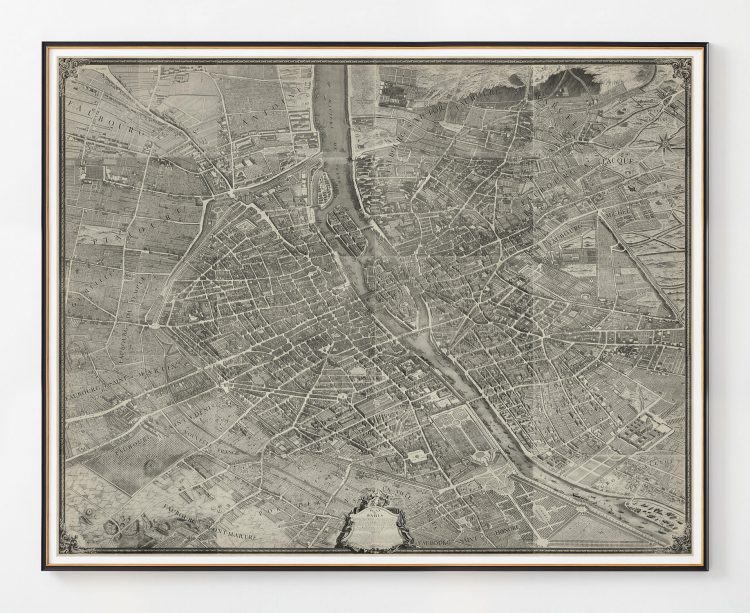
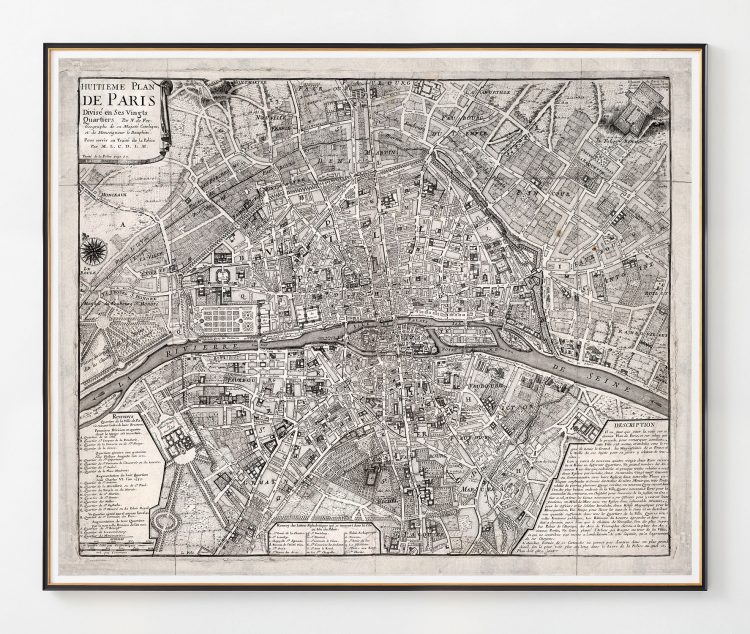
This 1734 Paris map was originally printed in the form of a book and printed onto 20 double pages.
This map is sold in five different ways:
- Wallpaper (118" W x 92.5" H)
- A full map print (greyscale or color):
- 118" x 92.5" ( 3 Printed Piece's ) - 101" x 79" ( 3 Printed Piece's) - 72" x 56.25" ( 2 Printed Piece's ) - 54.75"x 43" ( 1 Printed Piece )
- A series of 20 images building 1 large image (32.5" x 20.5" each)
- Any single plate or selection (32.5" x 20.5" each)
- Custom (inquire Phone or
This e-mail address is being protected from spambots. You need JavaScript enabled to view it
)
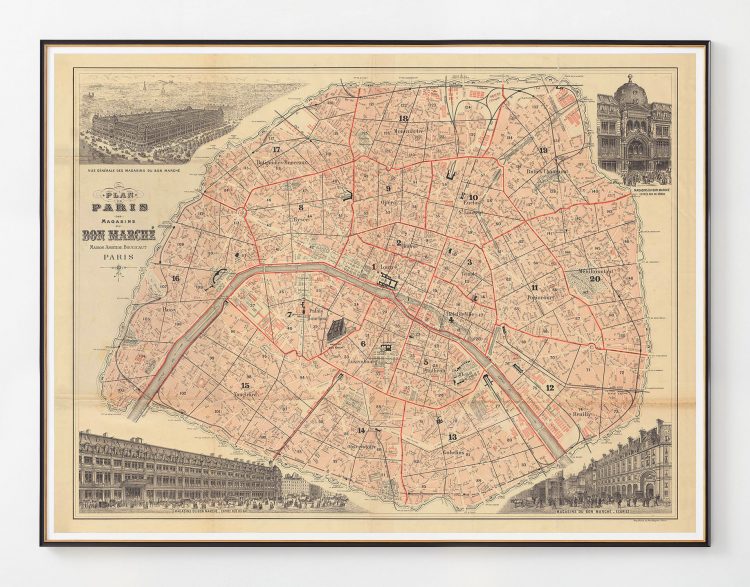
Here are some Examples of it being used.
In 1734, Michel-Étienne Turgot, chief of the municipality of Paris as provost of merchants, decided to promote the reputation of Paris for Parisian, provincial or foreign elites by implementing a new plan of the city. He asked Louis Bretez, member of the Academy of Painting and Sculpture and professor of perspective, to draw up the plan of Paris and its suburbs.
By contract, he asked a very faithful reproduction with great accuracy. Louis Bretez, was allowed to enter into the mansions, houses and gardens in order to take measures and draw pictures. He worked for two years (1734-1736).
The plan is in approximately 1/400e scale and arge (2.49 m * 3.18 m). In the eighteenth century, the trend was to abandon portraits of cities (inherited from the Renaissance) for a geometric plan, more technical and mathematical. But the plan de Turgot goes against this trend, by choosing the system of perspective cavaliere : two buildings of the same size are represented by two drawings of the same size, whatever the buildings that are close or distant. It is an isometric perspective.
The plan is oriented toward the southeast. It covers approximately the first eleven arrondissements.
In 1736, Claude Lucas, graver of the Academy of Sciences, created the 20 sheets of the plan. The plan was published in 1739, the prints were bound in volumes offered to the King, the members of the Academy, the Municipality and French foreign representations. The 20 engraved brass of the plan are kept by the Chalcography of the Louvre, where they are yet used now for re-printing with the same techniques that two centuries ago.
|

|